

Healthcare Marketing in 2027: The Complete Guide to Strategy, Channels, and Patient Trust


Patients now research a doctor the way they research a product/service. They search, read reviews, compare, and often decide before they ever call. That shift is what modern healthcare marketing is built around, and it’s why the old playbook of a billboard and a Yellow Pages listing no longer fills appointment slots.
This guide covers what healthcare marketing is, why it matters more than ever in 2026, the channels that work, how to build a strategy, the AI shift reshaping patient acquisition, and how to turn all that research into booked patients.
TL;DR:
- Healthcare marketing in 2027 rewards the providers patients can find, trust, and book without friction, not the ones who simply spend the most.
- Patients self-direct their care now. 84% check reviews before choosing a provider, 77% search online, 61% trust reviews over personal referrals, and 56% skip anyone under 4 stars.
- The channels that work. Local SEO and AI search, clinician-reviewed content, social media, email, video, paid campaigns, and an owned community.
- AI is the new front door. 47% of patients research providers with AI and 37% trust AI Overviews most, versus 20% for traditional links. Optimize to be cited, not just ranked.
- The biggest conversion leak is the trust gap. Your proof lives on Google and Facebook, not on the website where the appointment actually happens.
- Close it on-site with live reviews and ratings beside the booking button, a chat or click-to-call widget, and patient video testimonials.
- Compliance is non-negotiable. HIPAA consent for any patient content, no condition-based ad targeting, HIPAA-safe tracking, and E-E-A-T (clinician authorship) for medical content.
- Measure outcomes, not activity. Cost per booked appointment by service line, review volume and recency, and AI-search visibility.
What is healthcare marketing?
Healthcare marketing is the practice of attracting, informing, and retaining patients by promoting a provider’s services across digital and traditional channels. It spans everything from a hospital’s brand campaign to a single clinic’s Google reviews, and it balances growth with the ethical and compliance demands unique to healthcare.
Unlike selling a product, healthcare marketing deals with trust, anxiety, and high-stakes decisions. The job is not to pressure anyone. It’s to be present, credible, and easy to choose at the moment a patient is deciding where to go.
Why is healthcare marketing important?
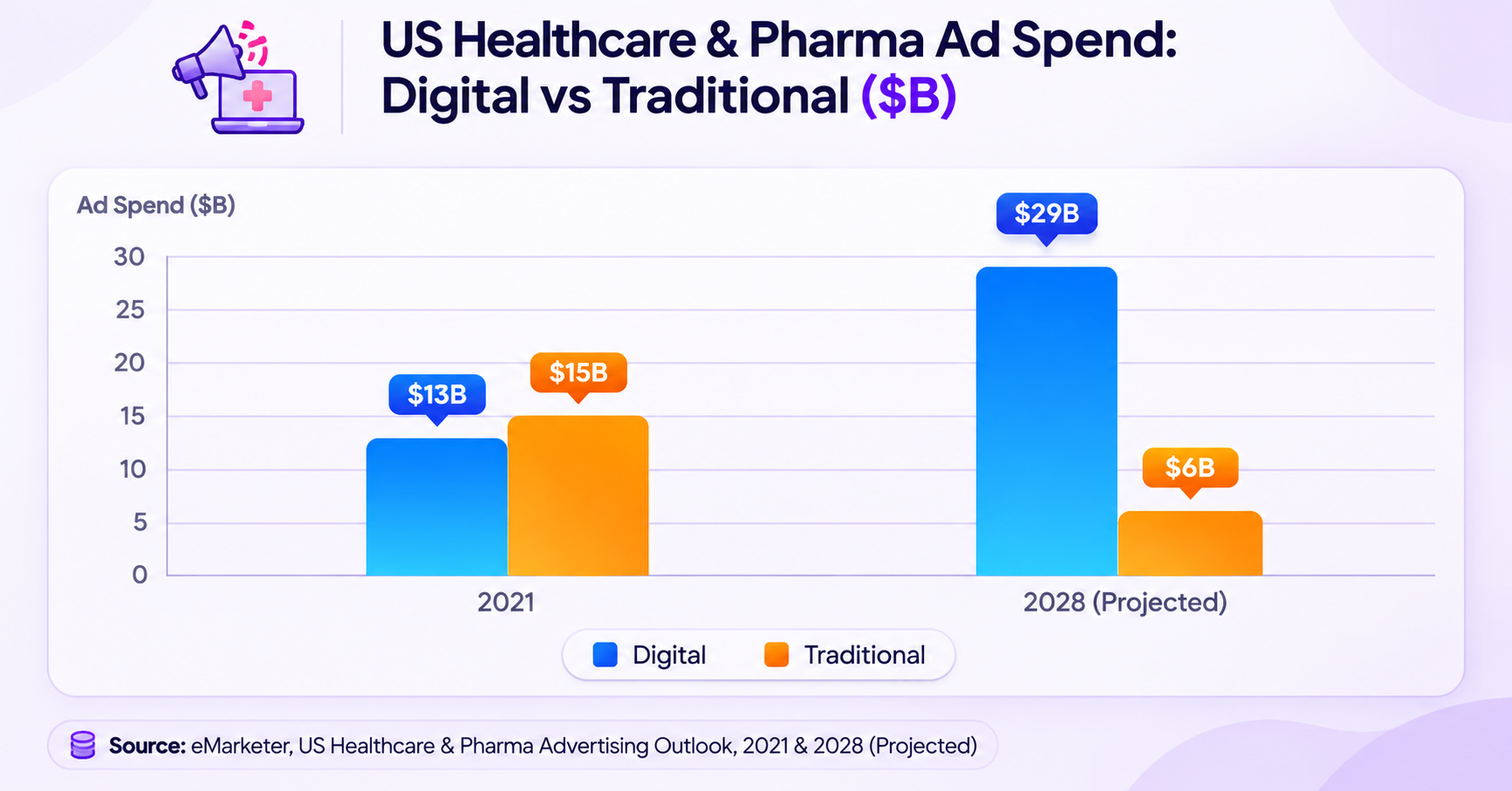
Because patient behavior has moved online, and the money has followed. The U.S. healthcare marketing and communications market reached $26.52 billion in 2026, up from $24.55 billion in 2025, and healthcare and pharma media spending is now roughly 80% digital, compared with 64% in 2022.
The bigger reason is how patients now choose care. They self-direct, they compare, and they trust strangers’ reviews over almost everything else.
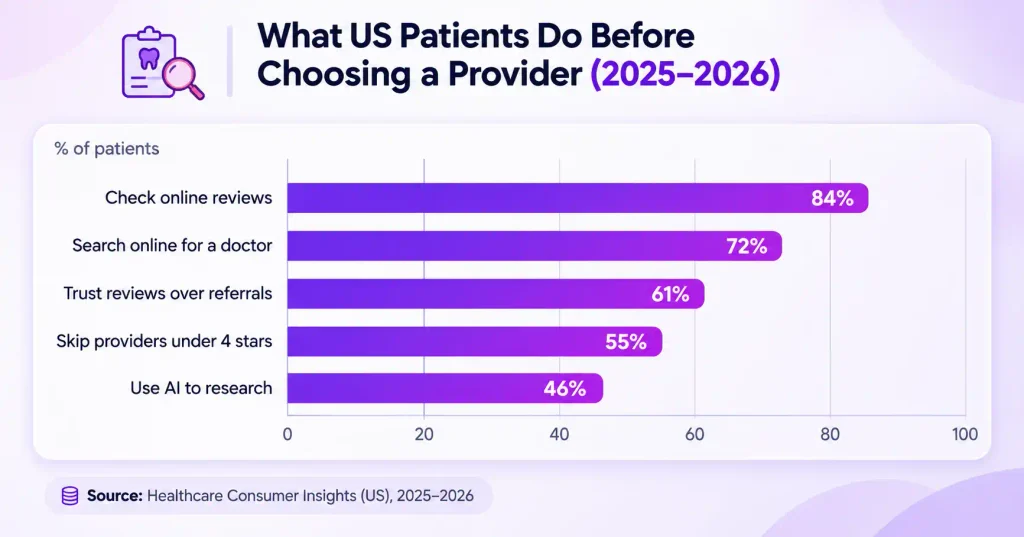
Two more numbers raise the stakes. 51% of patients read at least six reviews before deciding, and 40% have canceled or changed an appointment because of what they read. Marketing isn’t optional here. The research is already happening. The only question is whether your practice shows up well when it does.
Healthcare digital marketing: The channels that work
Digital marketing for healthcare now runs through a handful of channels, and almost every patient journey begins with a search.
The practices that grow aren’t the ones on every platform. They’re the ones that use a few channels well and connect them so no stage leaks. Here’s what each channel does, and how to make it earn its place.
Healthcare marketing SEO and AI search
SEO is still the foundation, because most journeys start with a search and 58% of patients begin on Google.
For a local practice, three layers do the work. Local SEO comes first. A fully completed, verified Google Business Profile, consistent name, address, and phone (NAP) across every directory, and a steady flow of recent reviews, since the map pack is where most near me clicks land. For example, Best Dentists Near Me.
On-page comes next, a dedicated page for each service line and each location, written the way patients actually search.
Technical comes last but can’t be skipped. Fast load, mobile-first design, and schema markup so search engines and AI understand who you are.
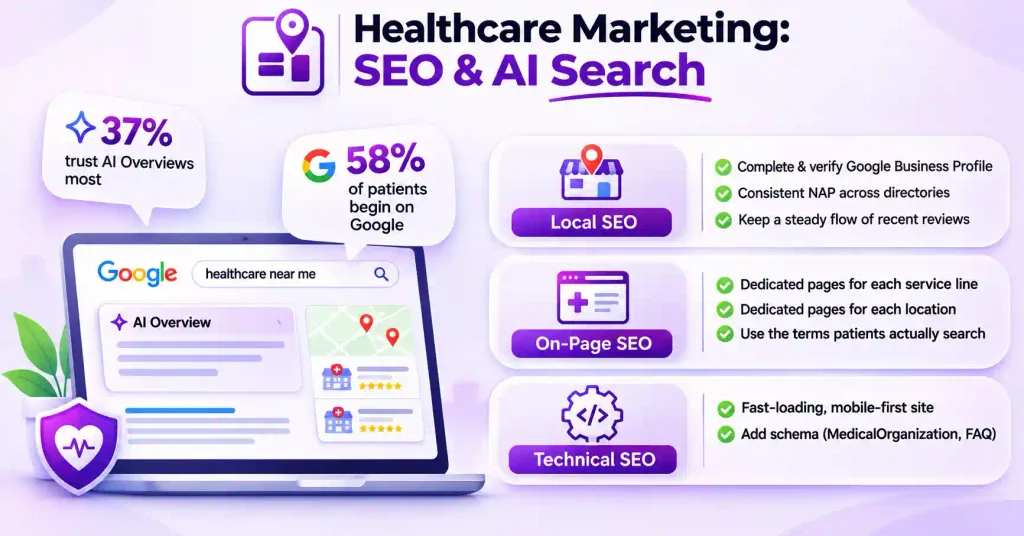
Search itself is changing, and this is the part to act on now. Google’s AI Overviews answer many health queries directly, and 37% of patients trust those summaries most, versus 20% for the old blue links.
To be the source an AI quotes, answer the question in the first two sentences of a page, cite real authorities, and keep your hours, services, and entity details identical everywhere. Because AI pulls from your whole footprint, not one page.
The must-follow basics: Claim and complete your Google Business Profile, fix NAP inconsistencies, add MedicalOrganization and FAQ schema, and keep reviews fresh. Those four moves do more for healthcare visibility than almost anything else.
Healthcare content marketing
Healthcare content marketing is creating accurate, genuinely useful information that answers the questions patients ask before they book, and builds the authority that makes you the obvious choice.
The highest-value topics follow the patient’s journey. Symptom and condition explainers for people just starting to look, procedure and what to expect guides for those deciding. Moreover, cost, insurance, and recovery answers for those ready to commit.
Each piece should feed the rest of your marketing, becoming an email, a social clip, and an answer an AI can cite.
Here’s the part you cannot cut corners on. Medical content is what Google calls Your Money or Your Life, so it’s held to the strictest quality standard the search engine has.
Every clinical piece needs a named author or medical reviewer with real credentials, a visible review date, and citations to primary sources like peer-reviewed studies or government health bodies, not other blogs.
Never publish a claim you can’t support, and never let AI draft clinical content without a clinician checking it. This is also your strongest advantage in AI search: well-sourced, expert-reviewed content is exactly what AI systems quote, and thin marketing copy is exactly what they skip.
Healthcare social media marketing
Social media is where awareness and trust compound between visits, but healthcare plays by rules other industries don’t.
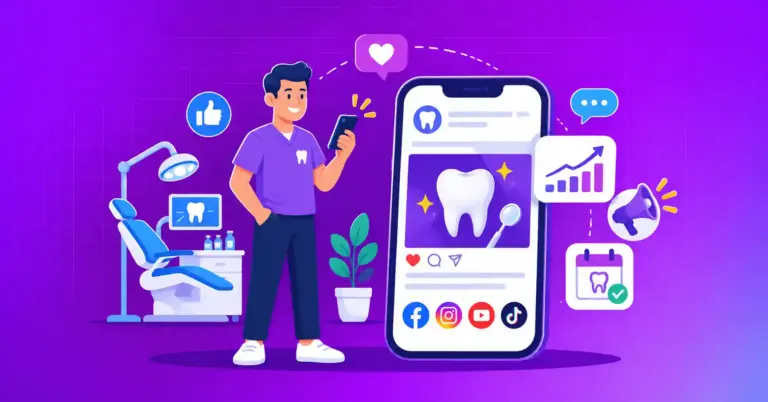
Match the platform to the goal: Facebook reaches local families and older patients, Instagram and TikTok show the human side of the practice to younger ones, and YouTube answers the questions people search before they book.
Build around a few repeatable content pillars, such as short procedure explainers, team and behind-the-scenes posts that ease anxiety, patient stories (with written consent), and answers to your most-asked questions. Consistency beats volume: two to four posts a week outperforms a burst that goes quiet.
One rule you cannot skip. Never post a patient’s information, image, or review without explicit written consent, and never reply to a public comment in a way that confirms someone is a patient.
On its own, that confirmation can be a HIPAA violation, so keep public replies general and move anything specific to a private channel. Then remember where social actually pays off. The activity lives on Instagram and Facebook, not on your website, where booking happens. Pulling that feed onto your site is where it converts, which the next sections cover.
Healthcare email marketing
Email is the highest-ROI channel in healthcare marketing, and the only one you fully own. No algorithm sits between you and the patient.
Practices that use it well go beyond the monthly newsletter: automated appointment reminders and recall campaigns (“you’re due for a cleaning”) that cut no-shows, post-visit follow-ups, and education segmented by service line, so new and returning patients get different messages.
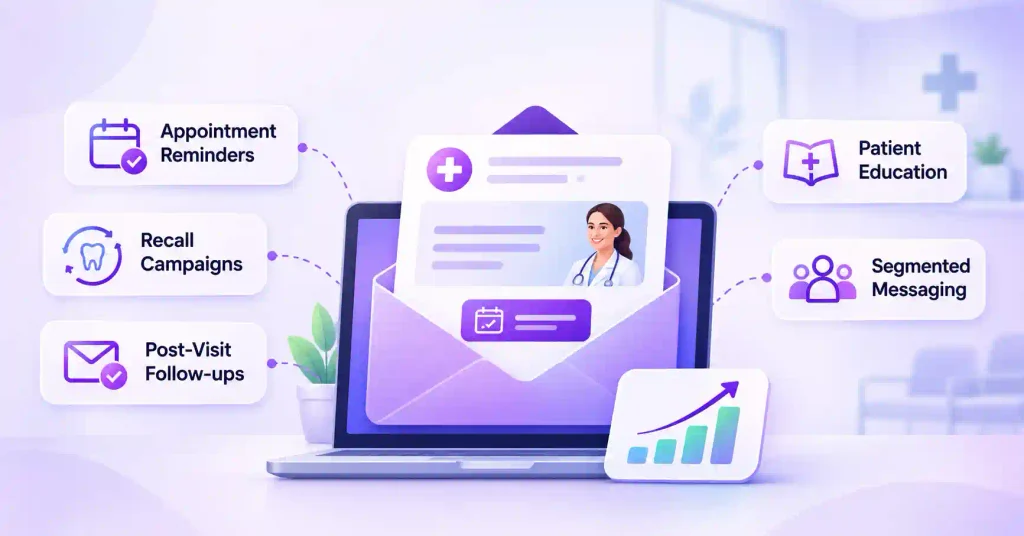
On WordPress, a self-hosted tool like FluentCRM runs this inside your own site. List segmentation, automated email sequences, and campaign tracking, with patient data staying in your own database instead of a third-party platform, which matters for compliance.
Healthcare video marketing
Video is the most persuasive format for a trust-driven decision. A 60-second clip of a provider explaining a procedure, or a patient telling their story on camera, reassures an anxious prospect more than any paragraph can.
Two formats do most of the work in healthcare: patient video testimonials, which turn a satisfied patient into on-screen proof, and short educational videos that answer the questions people ask before they book.
The catch is that most of this content lives on YouTube and nowhere else. Bring it back to your site: embed your recent YouTube videos on your pages so the channel keeps the site fresh automatically, and place testimonials near your appointment button where they reassure most.
On WordPress, a tool like WP Social Ninja can pull your latest YouTube content and display video testimonials without manual updates.
Paid healthcare marketing campaigns
Paid ads buy visibility while your organic presence builds, and in healthcare the channel mix matters. Google Search captures high-intent patients at the moment they’re looking for an emergency dentist near me.
Local Services Ads, with the Google Screened badge, put vetted providers at the very top of local results and charge per lead, not per click. Paid social works better for awareness and for retargeting people who already visited your site.
Across all of them, cost discipline is everything. Patient acquisition cost ranges from about $40 for urgent care to over $2,500 for behavioral health, so track cost per booked appointment by service line, not per click, and use call tracking, since many healthcare conversions happen by phone.
The must-follow for healthcare is compliance, because the rules are stricter than in any other industry.
Health is a sensitive category. You cannot target or retarget people based on medical conditions, and standard tracking pixels can leak protected health information, a mistake that has already cost providers major settlements.
Use HIPAA-compliant analytics and conversion tracking, keep PHI out of ad platforms entirely, and follow Google’s and Meta’s healthcare ad policies to the letter. Get this wrong, and the fines dwarf any campaign budget. Get it right and paid becomes a predictable tap you can turn up when you need more patients.
Healthcare community marketing
Most patient trust is built one visit at a time, but a community compounds it. A dedicated space where patients and prospects ask questions, share experiences, and hear from your team turns one-time visitors into a loyal audience you own, the way WPManageNinja has grown an engaged community around its products.
For a practice or health brand, that might be a members’ area for a condition, a wellness program, or a post-treatment support group.
The key is owning the community instead of renting it on Facebook, where an algorithm controls reach and moderation is hard to manage.
On WordPress, a tool like FluentCommunity lets you build a branded community on your own site, with discussion spaces, courses, and member profiles you control.
Done right, it becomes a retention and referral engine that carries your brand forward, not someone else’s platform.
How to build a healthcare marketing strategy
A healthcare marketing strategy maps your channels to the patient journey so no stage leaks. The strongest healthcare marketing plan isn’t a list of tactics; it’s a funnel: awareness, consideration, decision, retention, each with a goal and a measurable next step.
A practical five-step framework:
- Define your patients and service lines: A med spa, a cardiology group, and a dental clinic have different margins, acquisition costs, and buyers. So segment first.
- Audit your digital front door: Your website, Google Business Profile, and reviews are where decisions happen. Fix these before spending on ads.
- Build the awareness layer: SEO, local search, and content to get found; paid to fill gaps while organic grows.
- Close the consideration-to-decision gap: This is where most practices lose patients. Strong research, weak proof at the booking moment. Reviews, video, and instant contact go here.
- Retain and recall: Email and SMS to bring patients back and drive referrals.
| Funnel stage | Patient mindset | Channel | Goal |
| Awareness | I have a problem | SEO, content, social, paid | Get discovered |
| Consideration | Who’s good? | Reviews, video, social proof | Build trust |
| Decision | I’ll book one | Website, chat, booking | Remove friction |
| Retention | I’ll book one | Email, SMS, portal | Recall and referral |
A compliance note that most guides skip: healthcare marketing operates under HIPAA and advertising rules. Never publish patient information or a testimonial without explicit written consent, keep PHI out of ad targeting and analytics, and make medical claims you can defend. Trust is the whole game here, and a compliance misstep destroys it faster than any campaign can build it.
Healthcare marketing trends in 2027: AI becomes the front door
Heading into 2027, AI is no longer a layer on top of search. It’s becoming the front door to care. Patients increasingly start with an AI assistant instead of a list of links, asking it to compare providers, summarize reviews, and suggest who to book.
Nearly half already research providers this way, up from roughly a third just months earlier, and the curve is still climbing. When the AI answers the question, your website is no longer the first thing a patient sees. The AI’s summary is.
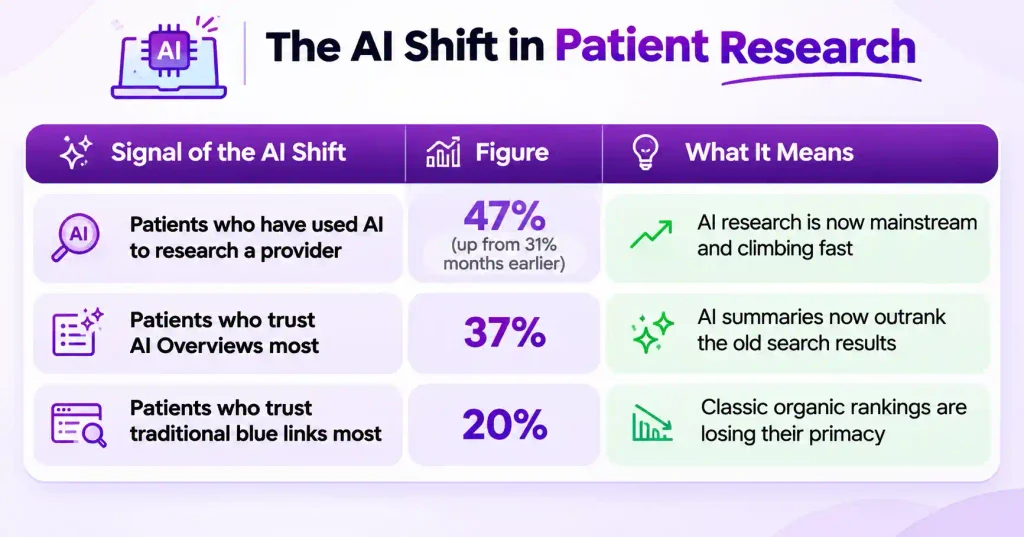
That changes the job. Winning in 2027 means being cited by AI, not just ranked by Google. Answer questions clearly, keep your entity details consistent everywhere, and maintain strong, recent reviews, because AI summaries rely on them.
Expect three moves to go mainstream. Agentic AI that books and triages appointments, AI voice agents as standard patient-facing support, and answer-engine optimization sitting beside traditional SEO.
AI in healthcare marketing is no longer optional. The practices that treat it as the primary discovery channel, not a side experiment, are the ones patients will still find.
Healthcare marketing agency, consultant, or in-house?
Most organizations use a mix. The right choice depends on budget, in-house skill, and how fast you need results.
A healthcare marketing agency brings specialized channels and compliance experience; a consultant sets strategy you execute yourself; an in-house team owns the day-to-day and brand voice.
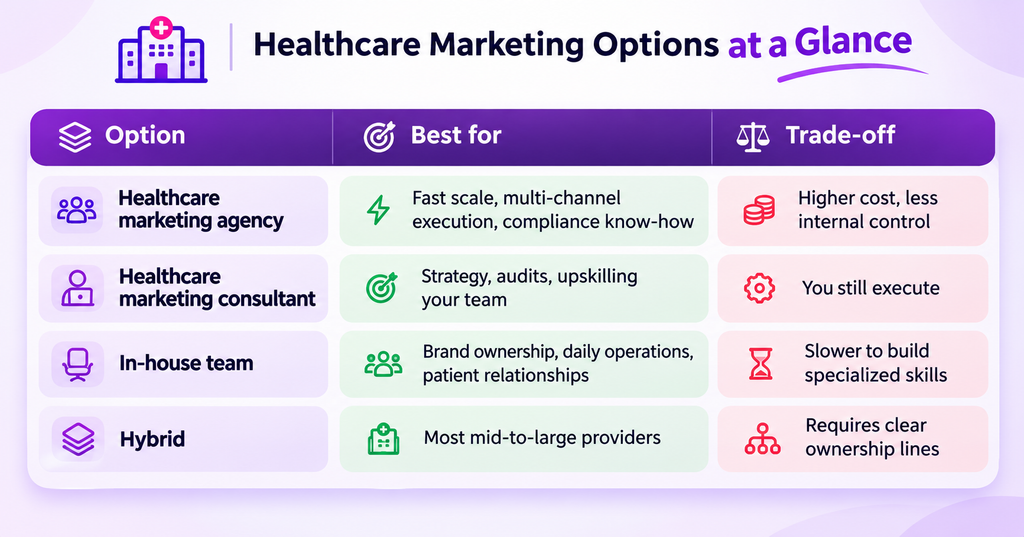
When evaluating healthcare marketing companies or firms, look for proven results in your specialty, genuine compliance fluency, and transparent reporting, not just a big client logo wall.
How to measure healthcare marketing
The point of measurement is to connect spend to booked patients and retention, not to count likes and impressions. Vanity metrics make a dashboard look busy while telling you nothing about growth.
Tie every channel to a patient outcome, measure it by service line (a new implant patient is worth far more than a routine cleaning), and review the numbers on a set cadence so you can move budget toward what actually fills chairs. These are the metrics that matter.
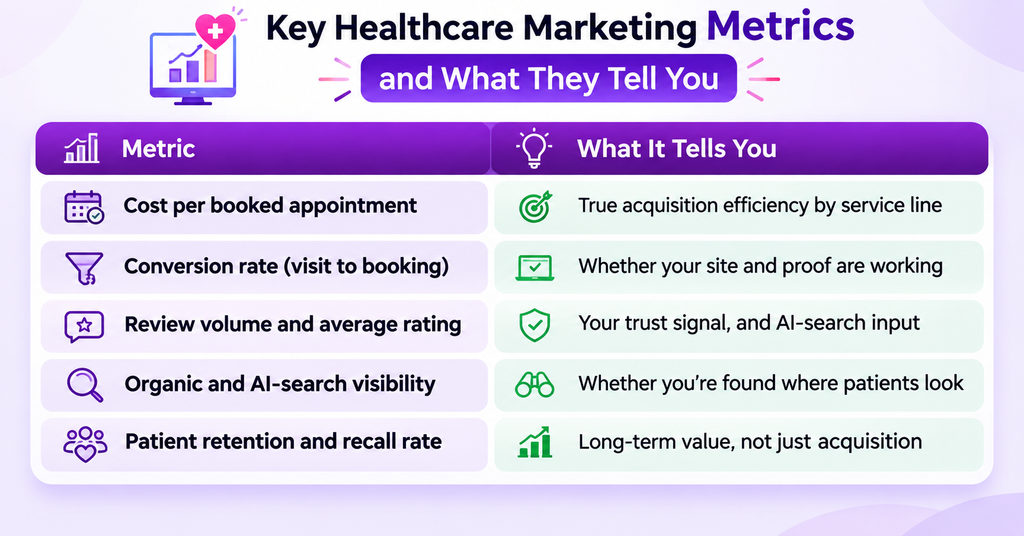
Two things make these numbers trustworthy. First, attribution: use call tracking, form-source tags, and UTM links so you know which channel produced each booking, not just each click.
Call handling matters as much as ad spend here, since a booking lost on the phone still cost you to generate. Second, cadence and context: track review volume and recency month over month. Because patients weight recent reviews heavily, watch how often you respond to reviews, and benchmark each metric against your own trend line rather than an industry average. Since acquisition cost swings wildly by specialty.
The bottom line
Healthcare marketing in 2027 rewards the providers patients can find, trust, and book without friction. The data is one-directional: patients research online, rely on reviews, and increasingly ask AI.
The winners aren’t the ones who spend the most. They’re the ones who show up credibly in search, and then prove that credibility on their own website, at the exact moment a patient decides. Get the trust layer right, and every other channel works harder.
FAQ
What is healthcare marketing?
Healthcare marketing is how providers attract, inform, and keep patients by promoting their services across digital and traditional channels, while meeting healthcare’s ethical and compliance standards. It covers SEO, reviews, content, social, email, video, and paid campaigns.
Why is marketing important in healthcare?
Because patients now self-direct their care. 84% check online reviews before choosing a provider and 77% search online for doctors. If your practice isn’t visible and credible online, patients choose a competitor who is.
What is healthcare content marketing?
Healthcare content marketing is creating accurate, useful information, such as condition guides and procedure explainers, usually authored or reviewed by a clinician, to answer patient questions, build authority, and feed SEO and AI search.
How does the healthcare industry use marketing?
To get found (SEO, local, paid), build trust (reviews, content, video), convert researchers into booked patients (website, chat, booking), and retain them (email, SMS, recall campaigns).
What’s the difference between healthcare marketing and medical marketing?
They overlap heavily. Medical marketing usually refers to promoting a specific practice, physician, or medical product, while healthcare marketing is the broader umbrella covering hospitals, systems, clinics, and services.

Subscribe To Get
Weekly Email Newsletter
Connect, Customize, and Display Social Feeds, Reviews, and Chat widgets







Leave a Reply