

SEO for Restaurants in 2027: How to Get Found on Google and AI


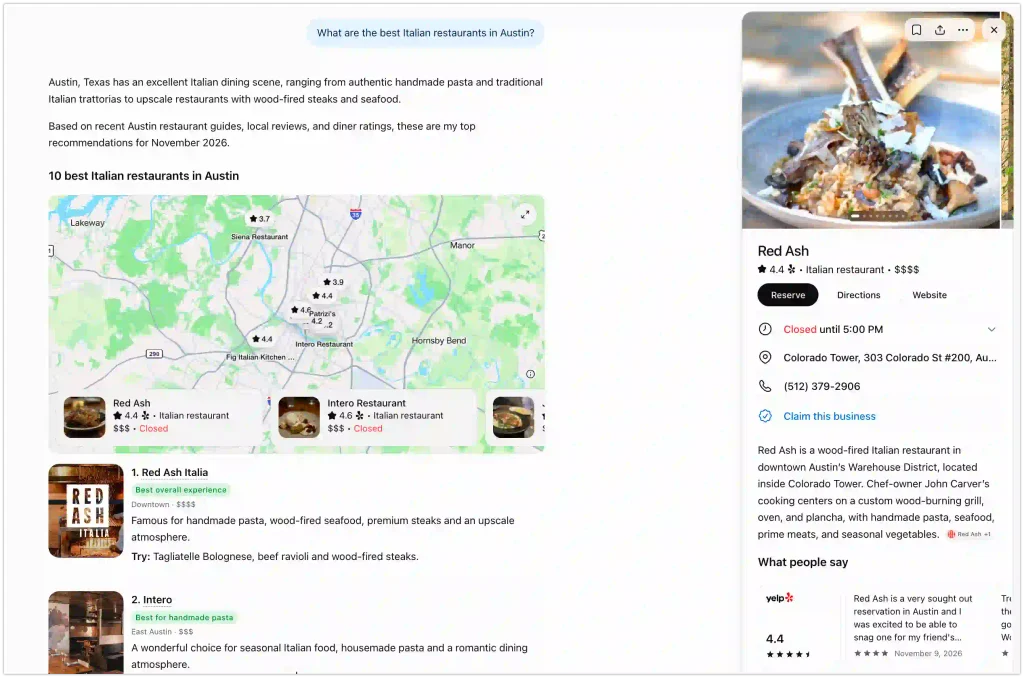
A diner in Texas opens ChatGPT and types Best Italian restaurant in Austin. It returns five names. Out of the thousands of Italian restaurants in the area, why those five?
That question is the new center of SEO for restaurants. Search is splitting in two: people still Google, but a fast-growing share now ask ChatGPT, Gemini, Perplexity, or read Google’s AI Overview instead of scrolling ten blue links.
And the thing that decides who gets named, in both the map pack and the AI answer, is the same: your reviews.
This guide explains how restaurant SEO works now, why AI recommends some restaurants and skips the rest, and how to build the review footprint that gets you into the shortlist.
TL;DR:
- 45% of consumers now use AI tools like ChatGPT to find local businesses, up from 6% a year ago, and restaurants are the top category they research this way.
- AI has no restaurant database of its own. It pulls reviews from the platforms it trusts: ChatGPT from Yelp and Foursquare, Perplexity from TripAdvisor, Gemini from Google.
- It names only a tiny shortlist. ChatGPT recommends about 1.2% of businesses per query, so 83% of restaurants never appear. The ones that do have deep, fresh, consistent reviews above roughly 4.4 stars.
- To get into that shortlist: keep your details identical across every platform, collect more reviews (a QR code and a Write a Review button), and display them on your site with review schema so machines can read them.
- WP Social Ninja does all three in one plugin. Collect reviews, display your Google, Yelp, and TripAdvisor ratings, and keep them synced and machine-readable.
What is the best SEO for restaurants?
The best SEO for restaurants is a reputation strategy, not just a keyword strategy. It rests on three pillars: local SEO (your Google Business Profile and listings), restaurant website SEO (a fast, readable site with reviews and schema), and the new AI layer (being visible to ChatGPT and AI Overviews).
Reviews feed all three, which is why they’re the highest-leverage work you can do.
Everything below builds on that: get found on the platforms diners and AI both read, and make your reputation easy for a machine to verify.
Search is moving from Google to AI
Local discovery has hit a tipping point. In 2026, 45% of consumers used an AI tool like ChatGPT to find a local business, up from just 6% a year earlier, a more than sevenfold jump in a single year.
Meanwhile, Google’s share of local recommendations slipped from 83% to 71% as AI took a chunk of the discovery journey.
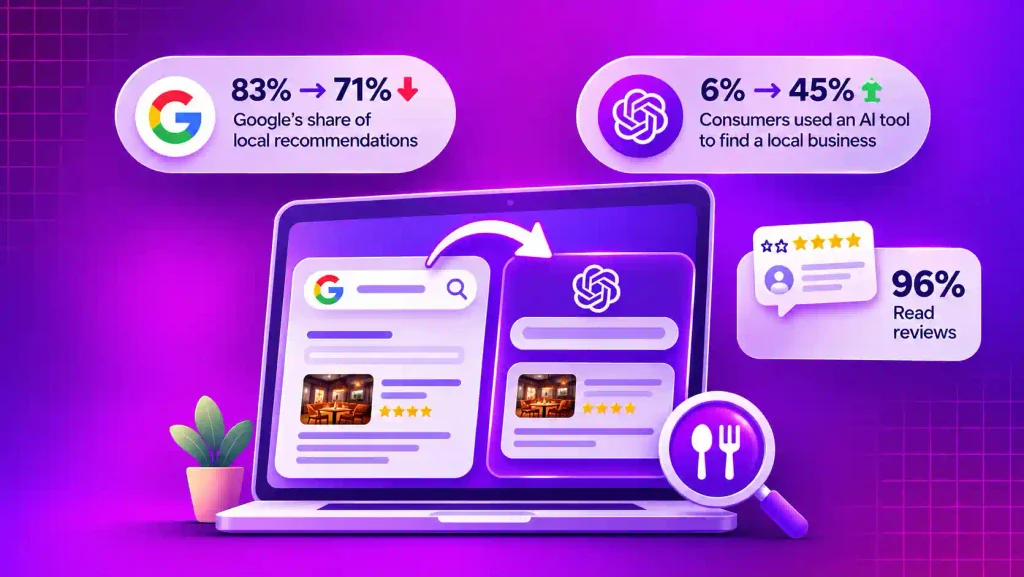
This is why restaurant reviews and AI search now belong in the same sentence. The behavior is real, but trust is still provisional. 96% of consumers read reviews before their first purchase, and 95% of consumers verify and fact-check what AI tells them before they commit.
The restaurants that win are the ones whose reputation holds up when a diner cross-checks the AI’s answer.
Why AI recommends those five restaurants (the mechanism)
Here’s the part most owners get wrong; ChatGPT has no secret list of good restaurants and no map of its own.
When someone asks for the best Italian in Austin, it runs a live lookup and assembles an answer from the review sources it trusts, then names a tiny handful. Understanding those sources is the whole game.
Each AI engine leans on different review data:
| AI engine | Where it gets restaurant data | What that means for you |
|---|---|---|
| ChatGPT | Licensed Yelp and Foursquare data, plus live web search of your site, Google listings, and press | Your Yelp listing and website matter as much as Google |
| Google AI Overviews, AI Mode, Gemini | Google Business Profile, Google Maps, reviews, Google’s index | Your Google Business Profile is the foundation |
| Perplexity | Licensed TripAdvisor data, plus live web search | TripAdvisor and consistent listings carry weight |
| Claude | Live web search results and your public web presence | A readable, consistent website and listings |
The data backs this up. In a BrightLocal study of nearly 61,000 local AI checks, Yelp appeared as a source in 80% of ChatGPT’s local answers.
OpenAI licenses Yelp’s and Foursquare’s data for ChatGPT; Perplexity licenses TripAdvisor’s; only Google’s own Gemini is grounded directly in Maps.
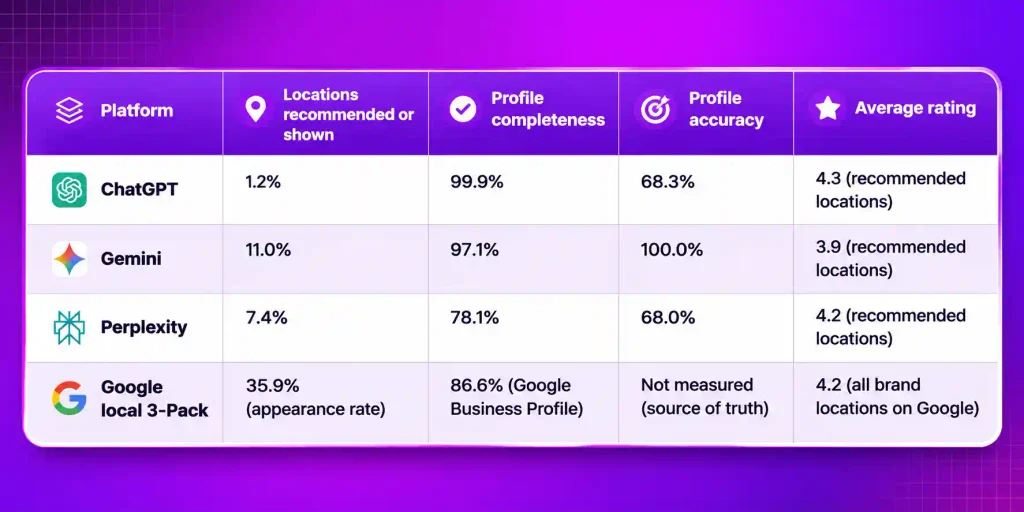
Then the AI filters hard. It checks that your name, address, phone, hours, and cuisine match across platforms, and if they conflict, it treats you as unreliable and skips you.
It favors restaurants with review consensus across several sources, recent and active reviews, a rating above roughly 4.3 to 4.4 stars, and a “quotable differentiator” it can point to.
The result is brutal math. ChatGPT recommends only about 1.2% of businesses per query, and one analysis of nearly 190,000 results found that 83% of restaurants never appear in ChatGPT recommendations at all.
Google and ChatGPT disagree on which restaurants to recommend 62% of the time, so ranking well on one doesn’t carry you on the other.
In short, the five restaurants that get named have deep, current, consistent reviews across the platforms the AI reads. That’s a reputation you can build.
Local SEO for restaurants: the foundation AI still relies on
Local SEO is the base layer, and it feeds the AI answer too. Claim and fully complete your Google Business Profile, keep your name, address, phone, hours, and cuisine identical everywhere, and bring in a steady flow of recent reviews.
The map pack and the AI recommendation draw from the same signals, so this work pays off twice.
Restaurant local SEO comes down to three habits. A complete, verified Google Business Profile with current photos and menu; consistent listings across Google, Yelp, TripAdvisor, Apple, Bing, and your booking platforms; and fresh reviews you actively ask for.
Inconsistency is the silent killer here, since a mismatch between your site and your listings is exactly what makes an AI skip you.
Restaurant website SEO: make your reputation machine-readable
Restaurant website SEO is about making your reputation easy for both Google and AI to read. The biggest miss is a site that gives machines nothing to parse: no reviews on the page, no star rating, no structured data.
Put your reviews on your website with review schema and an aggregate rating, and you give search engines and AI a clean, quotable record of your reputation on your own domain, which ChatGPT reads during its live search.
The restaurant search engine optimization basics still apply: fast load, mobile-first design, a plain-text menu (not an image or PDF), and dedicated pages for your location and key dishes.
But the differentiator in 2027 will be review schema markup, which makes your star rating eligible for rich results and gives AI a structured signal it can trust. Most restaurant sites skip it, which is exactly why there’s an opening.
How to get more reviews (The fuel for both)
Reviews are the one input that powers local SEO, website SEO, and AI recommendations at once, so volume and recency are your highest-leverage levers. The problem is that happy guests rarely write a review on their own. You have to make it frictionless and ask at the right moment.
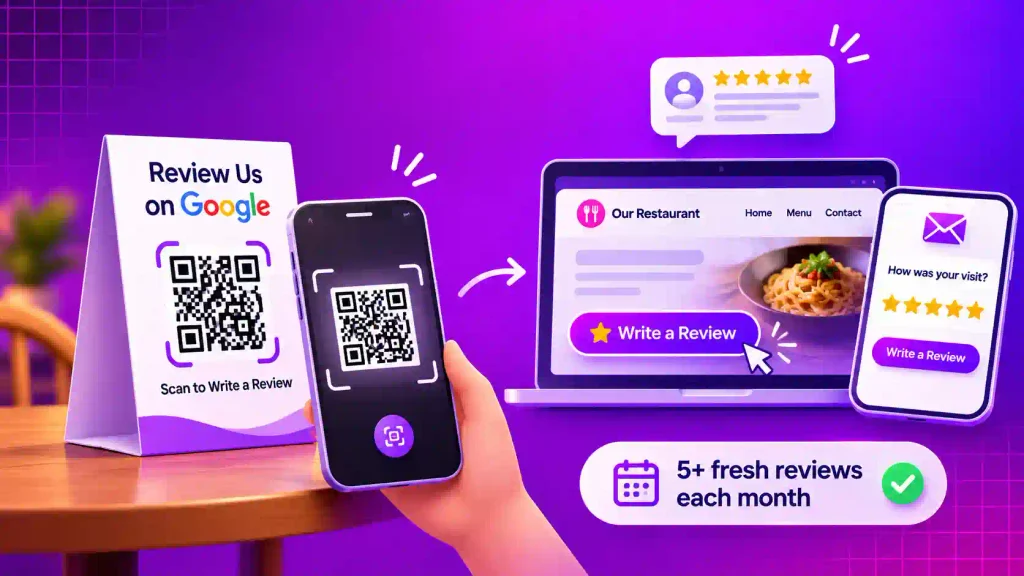
Two tactics do the heavy lifting. Put a Google review QR code on the table tent, the menu, the receipt, and the counter, so a guest can scan and leave a review before they’ve left their seat.
And add a Write a Review button wherever your guests already are, on your website and in follow-up messages. The goal is five or more fresh reviews a month across platforms, which is roughly what it takes to stay current in the AI’s eyes.
Do it all with WP Social Ninja
For a WordPress restaurant site, WP Social Ninja runs the entire review loop in one plugin, which is why it fits this job better than a stack of single-purpose tools. It covers the three moves the mechanism above rewards:
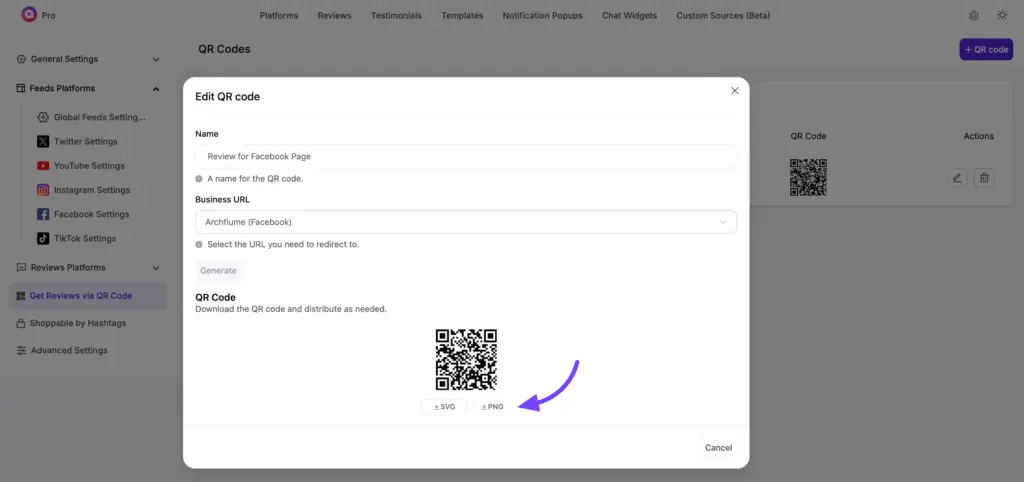
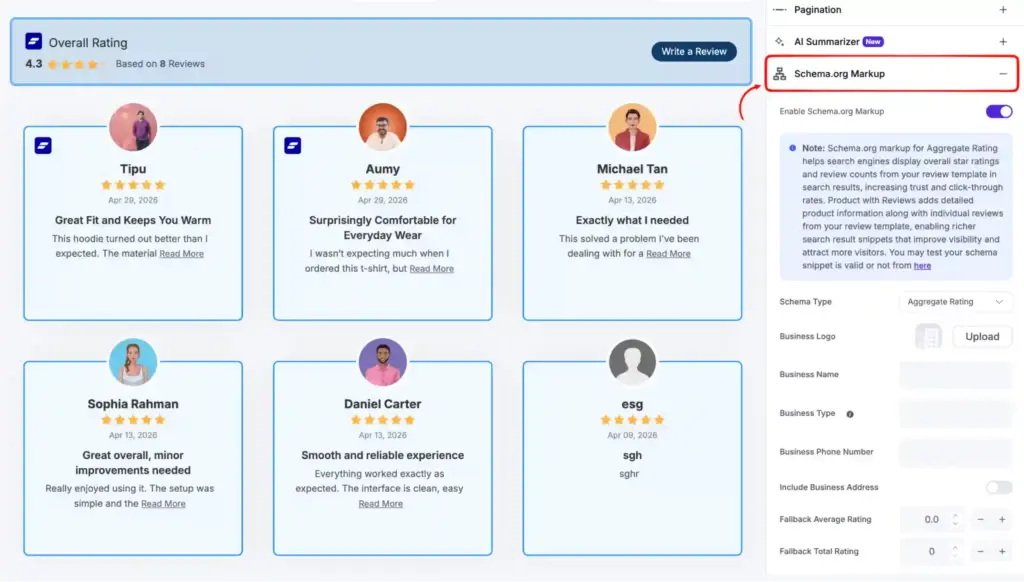
- Generate a QR code that sends guests straight to your Google review page, and add a Write a Review button on your WordPress website, so review volume and recency keep climbing without nagging.
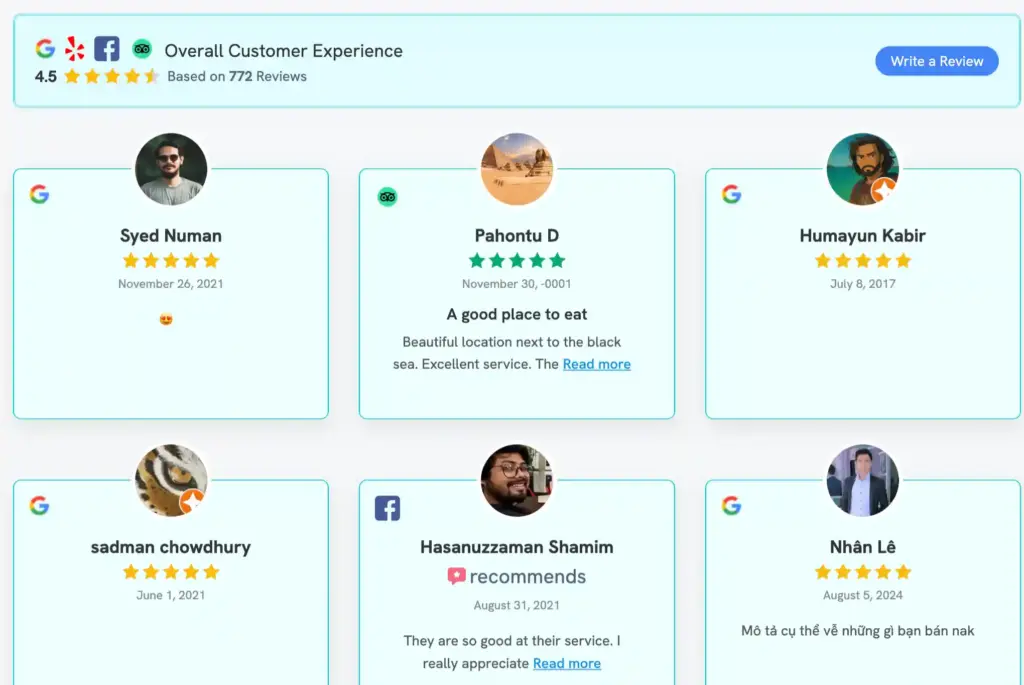
- Aggregate your Google, Yelp, and TripAdvisor reviews, the exact platforms AI trusts most for restaurants, into one display on your homepage and reservations page, with star ratings and verified badges so visitors and machines both see a real, consistent reputation.
- Built-in review schema gives AI and search a structured aggregate rating, auto-sync keeps your newest reviews showing, and an AI review summary distills a long review list into a quotable line.
No plugin can force ChatGPT to name you, and displaying reviews on your site doesn’t add them to Yelp or Google directly.
Win your customers’ hearts with exceptional features
Discover how WP Social Ninja can assist you in designing outstanding customer experiences.
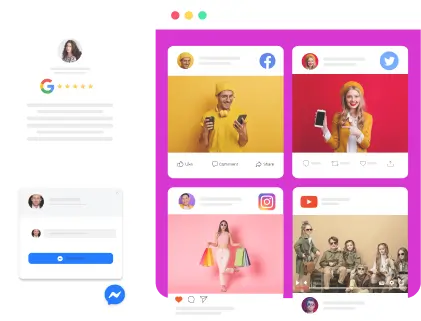
What WP Social Ninja does is help you earn more platform reviews (through the QR code and review button) and present a consistent, machine-readable reputation on your own domain, the two things that actually move you toward the shortlist.
Should you hire an SEO agency for restaurants?
You can do most of this yourself. An SEO agency for restaurants earns its fee on the technical and content-heavy work, site speed, schema implementation, link building, and ongoing content, especially for multi-location groups.
But the highest-impact task, collecting and displaying reviews across Google, Yelp, and TripAdvisor, is something a single owner can own with the right plugin and a consistent habit. Start there before you pay for anything.
Your 30-day restaurant SEO checklist
- Claim and fully complete your Google Business Profile, Yelp, and TripAdvisor listings, with matching name, address, phone, hours, and cuisine.
- Add a Google review QR code to tables, receipts, and the counter, plus a “Write a Review” button on your site.
- Embed your Google, Yelp, and TripAdvisor reviews with review schema on your homepage and reservations page.
- Publish your menu as plain text, not an image or PDF.
- Respond to every review, positive and negative.
- Track review volume and average rating monthly, and aim for 4.4+ stars and five or more fresh reviews a month.
The bottom line
SEO for restaurants in 2027 will be won by the restaurants whose reputation is loud, fresh, consistent, and readable, because that’s what both Google’s map pack and the AI shortlist reward.
The ones ChatGPT names aren’t the ones with the best food. They’re the ones with the strongest review footprint across the platforms it reads. Build that footprint and multi-angle reputation on online/offline, and you put yourself in the answer.
See how WP Social Ninja helps you collect, display, and sync the reviews that get your restaurant found on Google and recommended by AI.
FAQ
Q: What is the best SEO for restaurants?
Ans: A reputation-first strategy: a complete Google Business Profile, consistent listings across Google, Yelp, and TripAdvisor, reviews displayed on your website with schema, and a steady flow of fresh reviews. Reviews feed local SEO, website SEO, and AI recommendations at once.
Q: Does ChatGPT or other AI models use Google and Yelp reviews to recommend restaurants?
Yes. Specifically, ChatGPT licenses Yelp and Foursquare data and also searches the live web, including your site and Google listings. Yelp appeared as a source in about 80% of ChatGPT’s local answers in a 2026 BrightLocal study.
Q: How do I get my restaurant recommended by ChatGPT?
Keep your details identical across Google, Yelp, and TripAdvisor, earn deep and recent reviews on all three, stay above roughly 4.4 stars, publish a readable text menu with schema, and get mentioned in local press. AI recommends the restaurants it can find, understand, and trust.
Q: Does showing reviews on my website help SEO?
Yes. Reviews with schema give Google and AI a structured, quotable record of your reputation on your own domain, which supports rich results and gives AI a trusted signal. It also lifts on-page trust and conversions.
Q: How many reviews does a restaurant need to look credible?
There’s no fixed number, but consistency and recency matter more than a one-time total. Aim for a rating above 4.4 stars and five or more fresh reviews a month across platforms, since AI weights recent, active review patterns.

Subscribe To Get
Weekly Email Newsletter
Connect, Customize, and Display Social Feeds, Reviews, and Chat widgets









Leave a Reply